
Table of Contents
Have you ever wondered how a small company can raise capital without having to register with the SEC?
Are you a sophisticated investor or not?
The legalities involved can be intricate and daunting, but Sutter Law is here to take care of you.
Let’s dive into the requirements.
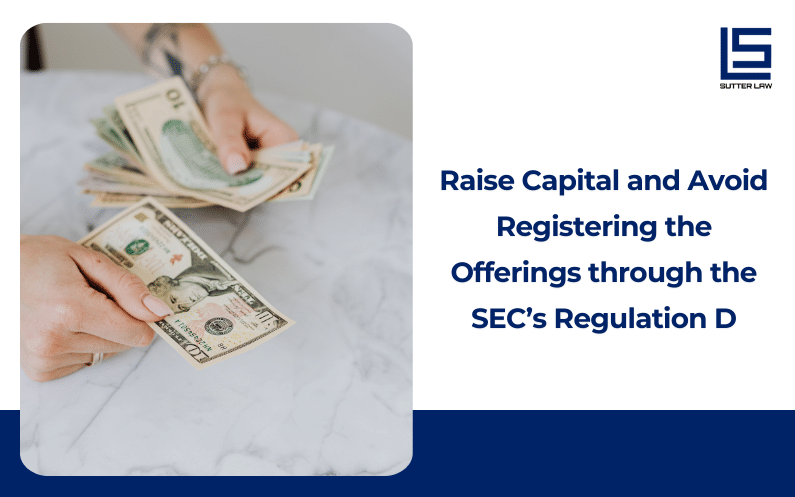
Regulation D of the Securities Act (Reg D) allows companies to raise capital by offering equity or debt securities to investors, without having to register those offerings with the SEC.
Reg D is usually used by smaller companies and it enables the issuers to raise capital quickly and at a lower cost.
When a company raises money through Reg D, it must still meet some specially created state and federal regulatory requirements, including those set out in Rules 506(b) and 506(c) of the Securities Act regulation D.
Rules 506(b) and 506(c) came about when the SEC divided Reg D into a pair of sub-regulations to accommodate smaller companies under the Jumpstart Our Business Startups (JOBS) Act.
The SEC did this to make it easier for smaller companies to attract investors.
Under Section 4(a)(3) of the Securities Act, Rule 506(b) grants an issuer the ability to offer an unlimited number of securities.
However, those offers must be made without solicitation or advertising, and there must also be a pre-existing relationship between the issuer and the investor.
Investors must either be accredited or meet the criteria of a “sophisticated investor.” This is an accredited investor who earned more than $200,000 in income (or $300,000 together with a spouse or spousal equivalent) in each of the prior two years.
They should reasonably expect the same for the current year. Or they can have a net worth over $1 million, either alone or together with a spouse or spousal equivalent (excluding the value of the person’s primary residence), or hold in good standing a Series 7, 65 or 82 license.
A sophisticated investor is a person who has – or the company offering the securities reasonably believes them to have – sufficient knowledge and experience in financial and business matters to evaluate the merits and risks of the prospective investment.
Any issuer offering or selling securities must ensure that the securities transaction is compliant with both the federal securities laws and state securities laws.
For a small business, undergoing a qualification process at the state level and registration at the federal level may be cost prohibitive, but exemptions may still be applicable to the securities transaction.
Applicable exemptions:
Rule 504 is an exemption from the registration requirements and allows certain companies (excluding investment companies and blind pool companies with no specific plan of business or purpose) to offer and sell up to $10 million of their securities in a 12-month period.
In contrast with Rule 506(b) and Rule 506(c), Rule 504 is only an exemption from federal securities laws and an issuer relying on Rule 504 must comply with state securities laws.
Therefore, an issuer must ensure that their offering is either qualified in California or exempted under the state securities laws.
California Disclosures:
In California, a business selling securities to a non-accredited and unsophisticated investor is subject to strict disclosure requirements under the SEC’s Rule 506(b) exemption.
The company must provide comprehensive disclosure documents, similar to those required in Regulation A, including detailed financial statements and other information about the business.
The company also needs to provide a way to answer questions from the investor and must file a notice with the SEC on Form D after the sale.
Regulation A Disclosure Requirements:
Regulation A disclosure requirements center on filing a comprehensive offering statement on Form 1-A with the SEC, which includes non-financial information about the company and the offering, plus a detailed “offering circular” for investors.
Financial statement requirements depend on the tier.
Tier 1 offers up to $20 million in a 12-month period and generally requires review but not auditing financial statements.
Tier 2 offers up to $75 million in a 12-month period and requires audited financial statements. Both tiers require the SEC to qualify the offering statement before sales can begin.
In summary
You avoid full SEC registration by using Reg D, but you must meticulously follow its specific requirements, especially concerning investor types and advertising, plus state laws, to stay compliant.
Are you a small company looking to raise capital without having to register with the SEC?
Or are you an investor wanting to make sure your investment is legal and safeguarded? Our Attorneys at Sutter Law are equipped and ready to guide you in this. Reach out today!